Summary

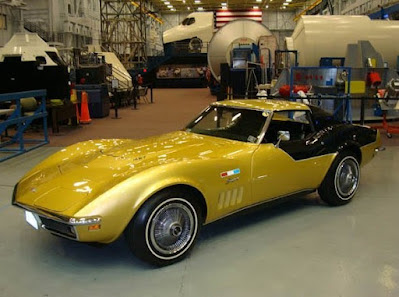
This Corvette you're looking at was built specifically for Astronaut Alan L. Bean. There were only two others made just like this one for two other astronauts, Richard Gordon Jr. and Charles "Pete" Conrad Jr. All three men were launched into orbit on the Apollo 12 mission, the second lunar mission to land on the Moon.
NASA and General Motors
GM President Ed Cole saw the potential of linking the NASA program to the GM brand for product growth. GM had already given astronaut Alan Shepard, the very first man to break his way into space, a new white 1962 Corvette with a custom space-age interior. GM had also done business with astronaut legends like Neil Armstrong and high-performance enthusiast Gus Grissom.
In the '60s and early '70s, NASA astronauts were like rock stars in America. Reaching the Moon before Russia was something America accomplished that helped bring a divided country together after the controversial Vietnam War.

Of course, it's hard to imagine GM giving away Corvettes, but Cole's decision to do so, according to his widow, Dollie (Chairman of the National Corvette Museum and Vice Chairman of the National Air & Space Museum), made sense to Cole.
"The astronauts were incredibly visible," she says. "And good publicity is good publicity."
But putting astronauts in Corvettes wasn't just about publicity.
"Who more worthy than guys who represent our country?" says Dollie. "They were literally risking their lives. Space travel today isn't 'ho-hum,' but people perceive it that way. There were so many unknowns then. The cars were a way of saying 'Thank you.'"
Executive GM Lease Program For NASA
Eventually, GM would see big benefits from being affiliated with NASA, so they went ahead and started an executive lease program for NASA employees. If you qualified for the lease program, you could lease a GM vehicle for $1 for one year.
According to astronaut Alan Bean, most qualifying employees chose Corvettes, making it an interesting sight when you drove past the Space Center and looked into the parking lot.
Eventually, GM would see big benefits from being affiliated with NASA, so they went ahead and started an executive lease program for NASA employees. If you qualified for the lease program, you could lease a GM vehicle for $1 for one year.
According to astronaut Alan Bean, most qualifying employees chose Corvettes, making it an interesting sight when you drove past the Space Center and looked into the parking lot.

Those Who Fly Together, Drive Together
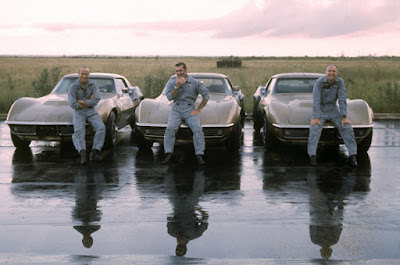
All three astronauts who boarded the Lunar Module for the Apollo 12 mission were very close, and all were car guys in their own right. They became good friends with Jim Rathmann, a Chevrolet and Cadillac dealership owner who was also known for winning the 1960 Indy 500.
Jim's dealership was located in Melbourne, FL, and its close proximity to the Space Center is what helped develop the friendship between the three astronauts and others at NASA, including Neil Armstrong.
With "Pete" Conrad Jr., Gordon Jr., and Bean successfully completing the Apollo 12 mission, they decided they should get matching Corvettes with some special visual upgrades to distinguish them from the rest of the Corvette owners and lessees.
All three astronauts who boarded the Lunar Module for the Apollo 12 mission were very close, and all were car guys in their own right. They became good friends with Jim Rathmann, a Chevrolet and Cadillac dealership owner who was also known for winning the 1960 Indy 500.
Jim's dealership was located in Melbourne, FL, and its close proximity to the Space Center is what helped develop the friendship between the three astronauts and others at NASA, including Neil Armstrong.
With "Pete" Conrad Jr., Gordon Jr., and Bean successfully completing the Apollo 12 mission, they decided they should get matching Corvettes with some special visual upgrades to distinguish them from the rest of the Corvette owners and lessees.
Rare Riverside Gold Corvette Color
It just so happened that in 1969, Corvette was offering a one-time-only Riverside Gold exterior color for the Stingray. The three astronauts joined forces with their friend and dealership owner, Jim Rathmann, who helped get all three gold Corvettes to his dealership.
No one really knows where the black "wings" were painted over the Riverside Gold base paint, but it wasn't at the factory or Rathmann's dealership. As the story goes, the three astronauts took a lot of time deciding what design they wanted before settling on the black "wings."


Rathmann decided to get his friend involved, Alex Tremulis. Tremulis was an industrial designer who held automotive design positions at Cord Automobile, Duesenberg, General Motors, Tucker Car Corporation, and Ford Motor Company before later establishing a consulting firm.
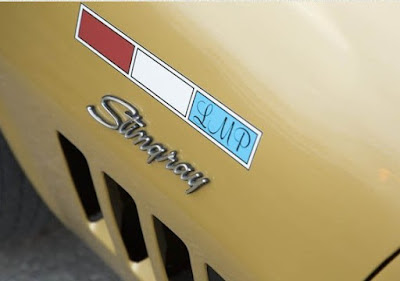
Tremulis and Rathmann both had a hands-on part in the design. Rathmann placed the white stripe that separates the black and gold colors, while Tremulis designed and painted the special red, white, and blue logos on the fenders.
Rathmann decided to get his friend involved, Alex Tremulis. Tremulis was an industrial designer who held automotive design positions at Cord Automobile, Duesenberg, General Motors, Tucker Car Corporation, and Ford Motor Company before later establishing a consulting firm.
Tremulis and Rathmann both had a hands-on part in the design. Rathmann placed the white stripe that separates the black and gold colors, while Tremulis designed and painted the special red, white, and blue logos on the fenders.

The Special Red, White, and Blue Emblems and The Meaning
The red, white, and blue emblems represent what you would think: America, the American flag, and NASA. Each emblem had a different set of initials drawn on a certain color of the emblem, representing the Corvette owner's rank during the Apollo 12 mission.
Bean's LMP initials were placed on the blue tag, signifying him as the Lunar Module Pilot. Pete's initials, CDR, were on the red tag of the emblem, standing for Commander. Dick's initials, CMP, for Command Module Pilot, were drawn on the white tag.
The colors the initials were painted on also represented the color each astronaut used to label his belongings during the Apollo 12 mission.

Corvette "AstroVette" Spec.
4-Speed Manual Transmission
490 Horsepower - 460 lb.-ft. of Torque
Four-Barrel Rochester Carburetor
Hydraulic Four-Wheel Disc Brakes
Fully Independent Suspension
Optional Side Exhaust Selected But Not Installed
Performance: 0-60 mph 6.0 Seconds; Quarter-Mile 14.3 at 93 MPH
One-Year-Only Riverside Gold
Special Steel Wheel Covers
Curb Weight: 3,450 lbs.

4-Speed Manual Transmission
490 Horsepower - 460 lb.-ft. of Torque
Four-Barrel Rochester Carburetor
Hydraulic Four-Wheel Disc Brakes
Fully Independent Suspension
Optional Side Exhaust Selected But Not Installed
Performance: 0-60 mph 6.0 Seconds; Quarter-Mile 14.3 at 93 MPH
One-Year-Only Riverside Gold
Special Steel Wheel Covers
Curb Weight: 3,450 lbs.

Where Are The Iconic "AstroVette" Stingrays Now?
Out of the three 1969 Stingray "AstroVette" Corvettes that were delivered to the Rathmann dealership for the crew of the Apollo 12 mission, only one is known to exist.
Alan Bean's Corvette is the last AstroVette known to exist. It was turned in after the $1, one-year lease was up. In 1971, it showed up in Austin, TX, on a GMAC car lot. It went up for auction, where a space enthusiast named Danny Reed put in a bid. He initially lost the auction, but the original winner couldn't come up with the money, and Danny eventually won the "AstroVette."
Out of the three 1969 Stingray "AstroVette" Corvettes that were delivered to the Rathmann dealership for the crew of the Apollo 12 mission, only one is known to exist.
Alan Bean's Corvette is the last AstroVette known to exist. It was turned in after the $1, one-year lease was up. In 1971, it showed up in Austin, TX, on a GMAC car lot. It went up for auction, where a space enthusiast named Danny Reed put in a bid. He initially lost the auction, but the original winner couldn't come up with the money, and Danny eventually won the "AstroVette."
Making the "AstroVette" Perfect
The Stingray "AstroVette" was put on track to be restored to its original state to preserve its integrity, which meant no full restoration. Danny Reed worked with many Corvette experts throughout the process to get it back to its original look—the way it would have looked when it came right off the assembly line, with overspray in the correct spots and everything.
The National Corvette Restoration Society (NCRS) has given it many awards at some of the most prestigious Corvette car shows in the world.
It has been on display at NASA events, the National Corvette Museum, the Kansas Cosmosphere, Florida Space Center, Johnson Space Center, Houston Space Center, in Washington, and many other worthy places.
Alan Bean has since been reunited many times with his now-famous "AstroVette." Bean became a painter after his days of walking on the Moon. Much of his painting work has to do with space and his moonwalking, as he wrote:
"Our time on the Moon ended much too quickly and, in the years since then, I have created paintings to try to capture the feeling of our Apollo 12 mission, as well as all the other Apollo missions, too. It's my hope that these paintings will help other people share in the great adventure."

How to Tell If You Found One of The Lost "AstroVette" Stingrays?
Just like all rare cars, there are some imposters out there, but there is a way to tell if you found a real "AstroVette."
Only these three Corvettes in the lease program were special-ordered and registered in the lessee's name. This featured Corvette has a tank sticker that says, "Courtesy car delivered to Alan L. Bean." If found, the other two would have a similar tank sticker with the corresponding astronaut's name—Richard Gordon Jr. or Charles "Pete" Conrad Jr.
All other Corvettes for the NASA executive lease program were put in the military's name.

There is nothing like a little Corvette and NASA history! The $1, one-year executive lease program for the astronauts ended in 1971. Whether or not it was because the Space Program became less popular and the executive lease program was less worthwhile from an advertising standpoint, I'm not sure.
But there was a time for a while when being an astronaut was better than being a Hollywood star or a pro athlete.