Showing posts with label Classic Cars. Show all posts

Friday, September 25, 2026

1969 Corvette Stingray "AstroVette" Apollo-Themed


1969 Corvette Stingray AstroVette

Summary

  • NASA + Corvette: GM connected the Corvette brand with NASA astronauts through cars, publicity, and an executive lease program.
  • Three Special Corvettes: Apollo 12 astronauts Alan Bean, Pete Conrad Jr., and Richard Gordon Jr. received matching 1969 Riverside Gold Stingrays.
  • The AstroVette Look: The cars received distinctive black "wings," a white dividing stripe, and special red, white, and blue astronaut emblems.
  • Big-Block Power: The AstroVettes packed 427-cu.-in. big blocks, four-speed manuals, and 490 horsepower.
  • Only One Known Survivor: Alan Bean's AstroVette is the only one of the three known to still exist.
  • A Piece of Space History: The car was preserved and restored to its original appearance and has been displayed at major Corvette and NASA-related venues.

  • 1969 Corvette "AstroVette" Stingray


    This Corvette you're looking at was built specifically for Astronaut Alan L. Bean. There were only two others made just like this one for two other astronauts, Richard Gordon Jr. and Charles "Pete" Conrad Jr. All three men were launched into orbit on the Apollo 12 mission, the second lunar mission to land on the Moon.

    NASA and General Motors
    GM President Ed Cole saw the potential of linking the NASA program to the GM brand for product growth. GM had already given astronaut Alan Shepard, the very first man to break his way into space, a new white 1962 Corvette with a custom space-age interior. GM had also done business with astronaut legends like Neil Armstrong and high-performance enthusiast Gus Grissom.

    In the '60s and early '70s, NASA astronauts were like rock stars in America. Reaching the Moon before Russia was something America accomplished that helped bring a divided country together after the controversial Vietnam War.


    1962 Corvette

    Of course, it's hard to imagine GM giving away Corvettes, but Cole's decision to do so, according to his widow, Dollie (Chairman of the National Corvette Museum and Vice Chairman of the National Air & Space Museum), made sense to Cole.

    "The astronauts were incredibly visible," she says. "And good publicity is good publicity."

    But putting astronauts in Corvettes wasn't just about publicity.

    "Who more worthy than guys who represent our country?" says Dollie. "They were literally risking their lives. Space travel today isn't 'ho-hum,' but people perceive it that way. There were so many unknowns then. The cars were a way of saying 'Thank you.'"


    Executive GM Lease Program For NASA 

    Eventually, GM would see big benefits from being affiliated with NASA, so they went ahead and started an executive lease program for NASA employees. If you qualified for the lease program, you could lease a GM vehicle for $1 for one year.

    According to astronaut Alan Bean, most qualifying employees chose Corvettes, making it an interesting sight when you drove past the Space Center and looked into the parking lot.
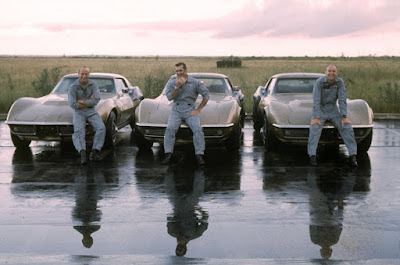

    Apollo 12 Astronauts With 1969 Corvette

    Those Who Fly Together, Drive Together

    All three astronauts who boarded the Lunar Module for the Apollo 12 mission were very close, and all were car guys in their own right. They became good friends with Jim Rathmann, a Chevrolet and Cadillac dealership owner who was also known for winning the 1960 Indy 500.

    Jim's dealership was located in Melbourne, FL, and its close proximity to the Space Center is what helped develop the friendship between the three astronauts and others at NASA, including Neil Armstrong.

    With "Pete" Conrad Jr., Gordon Jr., and Bean successfully completing the Apollo 12 mission, they decided they should get matching Corvettes with some special visual upgrades to distinguish them from the rest of the Corvette owners and lessees.


    Rare Riverside Gold Corvette Color

    It just so happened that in 1969, Corvette was offering a one-time-only Riverside Gold exterior color for the Stingray. The three astronauts joined forces with their friend and dealership owner, Jim Rathmann, who helped get all three gold Corvettes to his dealership.

    No one really knows where the black "wings" were painted over the Riverside Gold base paint, but it wasn't at the factory or Rathmann's dealership. As the story goes, the three astronauts took a lot of time deciding what design they wanted before settling on the black "wings."


    AstroVette 1969 Corvette

    1969 Corvette "AstroVette"


    Rathmann decided to get his friend involved, Alex Tremulis. Tremulis was an industrial designer who held automotive design positions at Cord Automobile, Duesenberg, General Motors, Tucker Car Corporation, and Ford Motor Company before later establishing a consulting firm.

    Tremulis and Rathmann both had a hands-on part in the design. Rathmann placed the white stripe that separates the black and gold colors, while Tremulis designed and painted the special red, white, and blue logos on the fenders.

    1969 Corvette Stingray


    The Special Red, White, and Blue Emblems and The Meaning

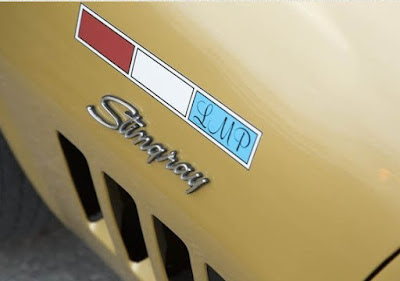
    The red, white, and blue emblems represent what you would think: America, the American flag, and NASA. Each emblem had a different set of initials drawn on a certain color of the emblem, representing the Corvette owner's rank during the Apollo 12 mission.

    Bean's LMP initials were placed on the blue tag, signifying him as the Lunar Module Pilot. Pete's initials, CDR, were on the red tag of the emblem, standing for Commander. Dick's initials, CMP, for Command Module Pilot, were drawn on the white tag.

    The colors the initials were painted on also represented the color each astronaut used to label his belongings during the Apollo 12 mission.


    396 cu. in. engine

    Corvette "AstroVette" Spec.

    • 427 cu.-in. Big Block L36 

    • 4-Speed Manual Transmission

    • 490 Horsepower - 460 lb.-ft. of Torque

    • Four-Barrel Rochester Carburetor

    • Hydraulic Four-Wheel Disc Brakes

    • Fully Independent Suspension

    • Optional Side Exhaust Selected But Not Installed

    • Performance: 0-60 mph 6.0 Seconds; Quarter-Mile 14.3 at 93 MPH

    • One-Year-Only Riverside Gold

    • Special Steel Wheel Covers

    • Curb Weight: 3,450 lbs.


    1969 Corvette "AstroVette"

    Where Are The Iconic "AstroVette" Stingrays Now?

    Out of the three 1969 Stingray "AstroVette" Corvettes that were delivered to the Rathmann dealership for the crew of the Apollo 12 mission, only one is known to exist.

    Alan Bean's Corvette is the last AstroVette known to exist. It was turned in after the $1, one-year lease was up. In 1971, it showed up in Austin, TX, on a GMAC car lot. It went up for auction, where a space enthusiast named Danny Reed put in a bid. He initially lost the auction, but the original winner couldn't come up with the money, and Danny eventually won the "AstroVette."


    Making the "AstroVette" Perfect

    The Stingray "AstroVette" was put on track to be restored to its original state to preserve its integrity, which meant no full restoration. Danny Reed worked with many Corvette experts throughout the process to get it back to its original look—the way it would have looked when it came right off the assembly line, with overspray in the correct spots and everything.

    The National Corvette Restoration Society (NCRS) has given it many awards at some of the most prestigious Corvette car shows in the world.

    It has been on display at NASA events, the National Corvette Museum, the Kansas Cosmosphere, Florida Space Center, Johnson Space Center, Houston Space Center, in Washington, and many other worthy places.

    Alan Bean has since been reunited many times with his now-famous "AstroVette." Bean became a painter after his days of walking on the Moon. Much of his painting work has to do with space and his moonwalking, as he wrote:

    "Our time on the Moon ended much too quickly and, in the years since then, I have created paintings to try to capture the feeling of our Apollo 12 mission, as well as all the other Apollo missions, too. It's my hope that these paintings will help other people share in the great adventure."


    Astronaut Alan Bean

    How to Tell If You Found One of The Lost "AstroVette" Stingrays?

    Just like all rare cars, there are some imposters out there, but there is a way to tell if you found a real "AstroVette."

    Only these three Corvettes in the lease program were special-ordered and registered in the lessee's name. This featured Corvette has a tank sticker that says, "Courtesy car delivered to Alan L. Bean." If found, the other two would have a similar tank sticker with the corresponding astronaut's name—Richard Gordon Jr. or Charles "Pete" Conrad Jr.

    All other Corvettes for the NASA executive lease program were put in the military's name.


    AstroVette 1969 Corvette

    There is nothing like a little Corvette and NASA history! The $1, one-year executive lease program for the astronauts ended in 1971. Whether or not it was because the Space Program became less popular and the executive lease program was less worthwhile from an advertising standpoint, I'm not sure.

    But there was a time for a while when being an astronaut was better than being a Hollywood star or a pro athlete.    

    Saturday, March 4, 2023

    1951 Buick LeSabre Concept | Harley J. Earl Advanced Technology The World Wasn't Ready For

    1951 Buick LeSabre Concept


    Summary

  • Way Ahead of Its Time: The 1951 Buick LeSabre packed technology that looked decades into the future.
  • Harley Earl: GM's legendary Head of Styling designed the radical concept and drove it for years.
  • Supercharged V8: A 215-cubic-inch aluminum V8 made an impressive 335 hp.
  • Futuristic Features: Hidden headlights, automatic jacks, rain sensors, dual-fuel capability, and backup electrical power made this Buick seriously advanced.
  • Jet-Age Styling: The wraparound windshield, dramatic curves, and aircraft-inspired interior made the LeSabre unlike anything else on the road.


    1951 Buick LeSabre Concept


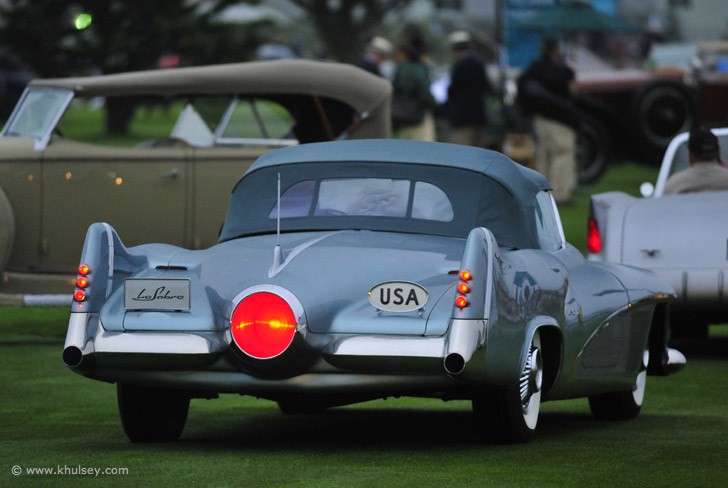
  • Back in 1951, this convertible Buick LeSabre was not just extreme-looking—it was way ahead of its time. It had technological advancements that weren't even thought of yet and would give us a sneak peek into the future of the automotive industry.

    Harley J. Earl was the lead designer of this beautiful piece of machinery. From 1927 to 1958, he was General Motors' Head of Styling and had his hands in the cookie jar of many breakthrough designs and technology projects that would change the auto industry for years to come.


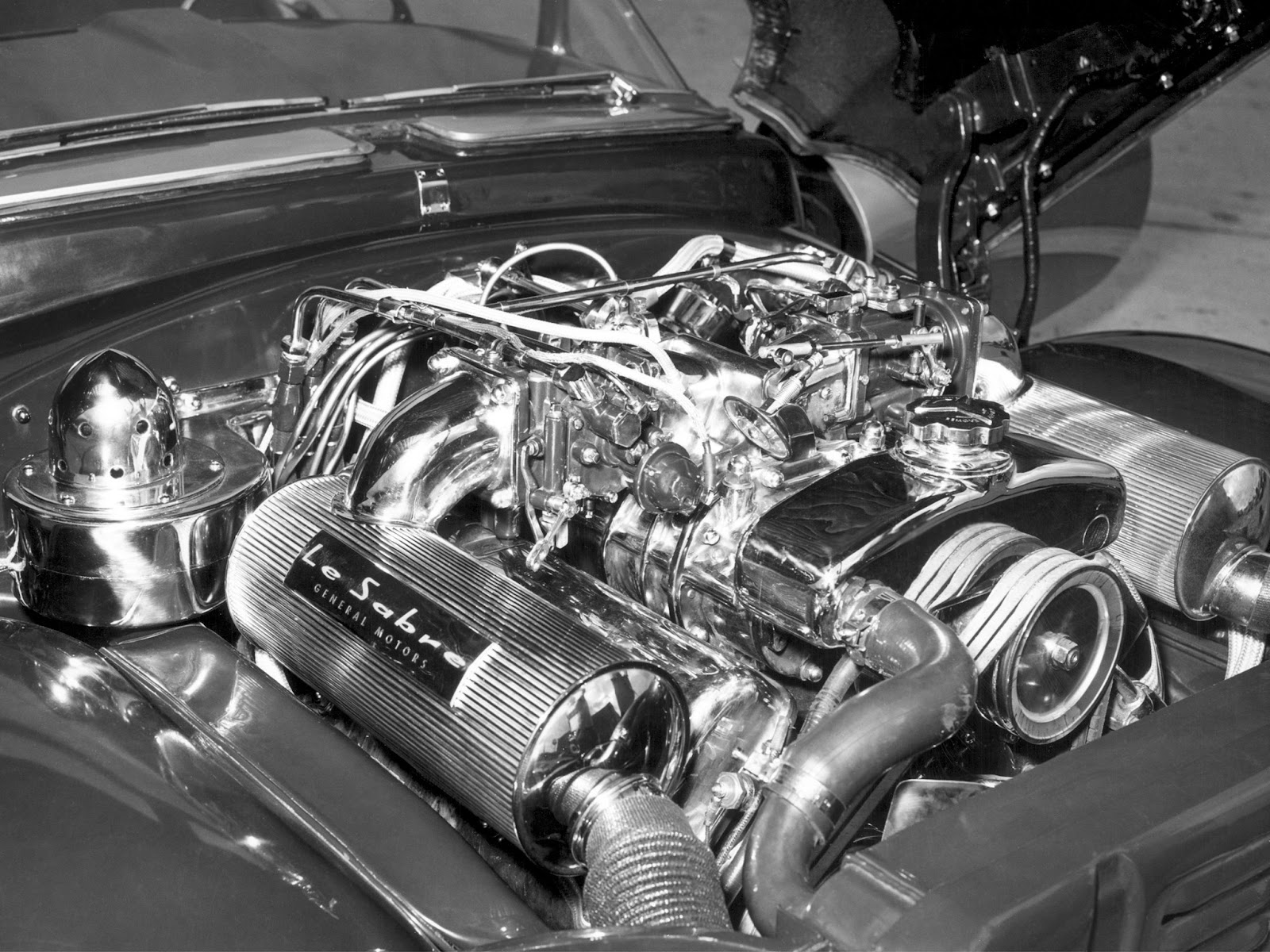
    One of the first things that really set this car apart was that it could function on gasoline and methyl alcohol. There were separate fuel cells for both sources and an easy way to switch between the two from the convenience of the driver's seat. It also had one of the first smaller engines that could produce high horsepower, much like what we see in today's vehicles. This Buick used a 215-cubic-inch V8 HEMI aluminum block topped off with dual carbs, aluminum heads, and a supercharger that produced 29.5 PSI. All these goodies made the engine good for 335 hp at 5,500 RPM. In 1951, that was an outstanding number for such a small engine.

    The styling was nothing short of artwork for this concept Buick. Earl designed the first wraparound windshield, which gave the driver a panoramic view of the road and surrounding areas. It also saw the likes of GM's first rear brake coolers, which used functioning rear scoops on the back quarter panels. The scoops were designed and positioned to cool the brakes and the battery located in the back.

    One of the very noticeable features that people hadn't seen too much of was the hidden futuristic headlights that would pop out from behind the grille with the flip of a switch. The Buick LeSabre also had a feature that, to this day, is only really used on Indy and Formula 1 cars. The automatic jack system was the first of its kind and allowed you to work under your car without a floor jack or jack stands.

    Maybe today, the feature doesn't sound like much, but think back to 1951 and the stock emergency jack that would be provided for you if you had an unfortunate flat tire. Remember, in '51, there were no cell phones to call AAA or a friend and no OnStar-type systems.

    Another feature that would really stun you back in 1951 was the automatic sensors that could recognize rain and put your ragtop and windows up without you being around to control them. The Buick even had a backup source of power, so if your battery died, you could still at least control features like the radio, windows, and ragtop.


    This concept was designed from Earl's imagination and his love for jet airplane designs. The sleek styling lines and flamboyant curves are what really set this Buick apart. The interior even showed a little bit of aeronautical passion, with a dashboard that included an altimeter, tachometer, and a compass.

    Earl adopted this 1951 Buick LeSabre as his own and drove it until he had about 50,000 miles on it before handing it over to the GM museum in the 1960s. Earl was a well-respected designer who became a legend along with his creations, like this one.

    Sunday, December 26, 2021

    '57 Chevy: One Of The Most Influential And Iconic Cars Of All Time!


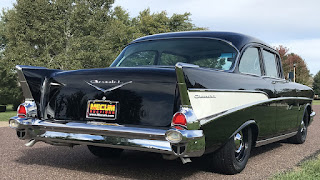
    '57 Chevy Bel Air

    How Did The 1957 Chevy Come About?

    It starts with Chevy's need for change. For the first time since 1918, Chevrolet was willing to offer a V8 in its 1955 Chevy sedan, and with that V8, Chevy thought it would be a good time to get rid of the shoe-box look that they were recently using and try something different. 

    Chevrolet Chief Designer, Ed Cole, wanted to get rid of the shoe-box look by 1956 and have a whole new look for 1957. Unfortunately, things didn't go as planned and the new look never launched forcing Cole and the design team to make do with the shoe-box style for one more year, but there were going to be big changes.

    To help differentiate the '57 from '55 and '56 Chevy, Cole brought in Harley J. Earl, a famous automotive designer. Earl had already had huge styling successes under his belt that not only worked out for General Motors, but also influenced the automotive world as a whole. 


    The changes Earl was making to the '57 Chevy would be widely ridiculed by Earl's co-workers, automotive experts, and anyone and everyone who just couldn't see his vision the way he did. 

    '57 Chevy Dramatic Transformation

    '57 Chevrolet

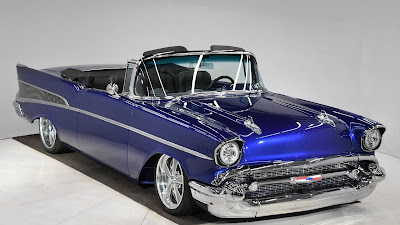
    Some of the changes were: A new dashboard, a reshaped windshield, sealed cowl, and 15-inch rims to replace the 16-inch rims. Also, Earl decided to relocate the air-ducts to the headlights, which gave the car the big distinctive chrome look in the front. Then he added the iconic quarter-panel fins to the rear to help make the Chevy six inches longer, ultimately giving the Chevy the lowered look that everyone recognizes today.

    1957 Chevy Fuel Injection


    Other intriguing things that were new with the '57 were a lighter front-end, a bigger engine bay, and new drivetrain options that included a fuel-injection system and a three-speed Hydra-Matic transmission. A dual exhaust was offered with all V8 options for a little more horsepower but more so for the cool sound that it would give the Chevy. 

    In commercials, magazine ads, and on billboards, the Chevy motto was always the same: "Chevy Puts The Purr Back Into Performance."

    1957 Chevy; New York Times


    A 1957 Chevrolet Coupe And Convertible For Everyone

    Different trim options helped make the car more affordable for the average family and classy enough for those who wanted the feel of something a little more luxurious.

    Trim Models Were As Followed:

    Base: 150 Series
    '1957 Base 150 Series


    Base: 210 Series
    '57 Chevy Based 210 Series


    Del Ray: 210 Series
    '57 Chevy Del Ray 210 Series


    Base: Bel Air
    '57 Chevy Bel Air


    Convertible: Bel Air
    1957 Chevy Convertible Bel Air


    Nomad: Bel Air (station wagon)
    1957 Chevy Nomad Bel Air


    El Morocco: custom hand-built to mimic a Cadillac
    1957 El Morocco


    Each version was available in a two-door or four-door body style. The base "150" series with an in-line six was not only priced very well for consumers on a budget but also did very well when it came to gas mileage compared to the V8s. 

    As you went up in models, you went up in comfort and class and, of course, in price. The Bel Air and Bel Air convertible was the most popular and expensive models, and in today's market, it is the most wanted by all collectors and car enthusiast alike, even if you're not a Chevy fan, you've probably wished you had a '57 Chevy at one point or another.

    Choose Your '57 Chevy Options

    Each version had options that could be ordered up to make the car more comfortable and luxurious. Some of those options were air-conditioning, power brakes, power steering, a padded dashboard, power windows, and power seats. Color schemes and chrome trim options were another way to show your impeccable taste in automobile selection.    

    Also, a signal-seeking radio with a power antenna could be purchased along with a separate speaker that could be placed in the back, and at that time, that's what automotive companies called surround sound. The "Automatic-Eye" was another new option. The Automatic-Eye was attached to your dashboard and could detect on-coming traffic and dim your headlights automatically - high-tech for 1957.


    '57 Chevy Engine Bay


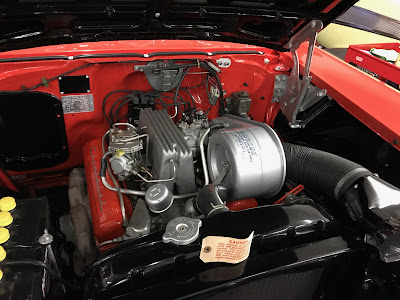
    One of the things that played a part in making the '57 Chevy so desirable was the bigger engine bay it came with. This was important because it made room for the big-block engines that Chevy was making for racing at the time. As drag racing became more popular and going fast was the thing to do, having a '57 Chevy that could accommodate Chevy's big-block engines with virtually no fabrication required was a huge plus to the go-fast racing enthusiast.

    Even without the big blocks, you could still make plenty of power by opting for what Chevy called the Power-Pack (283 cubic-inch engine with solid lifters, a 4 barrel carb, and dual exhaust), which would make 275 horsepower right off the showroom floor. 

    Fuel-Injection '57 Chevy


    Although the 283 cubic-inch motors would make 283-hp with fuel injection, that option was often overlooked by consumers at the time because very few people knew how to work on fuel injection setups. Even mechanics were having problems working on the new fuel-injection system. So, if you were buying the car to modify it and or race it, going with the carburated setup you already knew how to work on was a much smarter way to go.

    The odd thing about these desirable collector cars is that in 1957, the sales of Ford's '57 Fairlane model ended up out-selling the Chevy. Maybe it was the 1957 Chevy's bold chrome front-end or the rear-fins that threw consumers off. Maybe it was the introduction of the fuel injection and the 3-speed Hydra-Matic transmission - both of which consumers were skeptical about. Whatever the case was, by the time the '80s rolled around, these were considered one of the most, if not the most, collectible cars around.

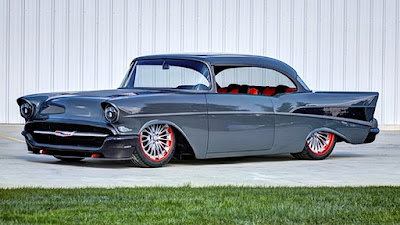
    '57 Chevy Custom


    Worth Every Penny

    Nowadays, a meticulously restored '57 Chevy Bel-Air can go for around $100,000.00 or more, and a seller could catch even more for a convertible in the same condition. But if you are thinking about buying one, you will want to be careful and maybe even seek some professional help before doing so. There are a lot of replicas out there, and it can be very easy to be fooled.

    Sunday, March 7, 2021

    The Chevrolet El Camino: The Most Successful Car/Truck

     Yellow SS El Camino

    The El Camino History 


    El Camino is a Spanish name that stands for "The Road". The name and the idea was first introduced to the public by Cadillac in 1954 at the Detroit Motorama. Even though it received some serious attention, the idea never set sail, and Cadillac would eventually drop the project after about one year.


    Ford saw the potential and came out with its own version of a car/truck called the Ranchero in 1957. The Ranchero saw such a good response from its consumers, like in true competitive fashion, Chevrolet was ready to get in on the game.  


    The El Camino by Generations 


    1959-1960 El Camino 

    1959 El Camino


    (First-Generation) 

    In 1959, Chevrolet relaunched Caddilac's El Camino idea based on the Chevy Impala Bel Air's frame and styling. But again, the El Camino still became a hard project to get on its feet, so the El Camino got the ax again after 1960.


    Experts believe the reason for the poor sales was that Ford downsized the Ranchero from a Ford Fairlane-based frame to a Ford Falcon-based frame. This ultimately made the Ranchero smaller and more desirable to drive. This left buyers heading toward Ford for the truck/car vehicle and forced Chevy to put the El Camino project back on the shelf.


    Engine

    235 cu.-in. I6

    283 cu.-in. V8

    348 cu.-in. V8


    Transmission

    3-speed manual

    4-speed manual

    2-speed Powerglide automatic


    1964-1967 El Camino 

    '66 El Camino


    (Second Generation)


    During the El Camino's hiatus, GM was taking notes on Ford's progress with the Ranchero. After a few years, Chevrolet decided they had the El Camino style and design right in the sweet spot for a relaunch in 1964. With a smaller frame and style based on the Chevelle, the El Camino started seeing good enough sales to keep it in Chevrolet's lineup for a while, a long while. The El Camino stayed on Chevrolet's roster for more than two decades with 1987 being the last year for the odd but successful Spanish-named car/truck.


    One of the things that helped keep the second-generation El Camino selling so well was the engine performance. Since it was based on a Chevelle, the El Camino came available with almost all the same upgrades that were available on the Chevelle, including the 327 cu.-in. motor in the first two years, then a beefed-up 396 cu.-in., starting in 1966. 


    Engine

    194 cu.-in. I6

    230 cu.-in. I6

    250 cu.-in. I6

    283 cu.-in. Small-Block V8

    326 cu.-in. Small-Block V8

    396 cu.-in. Big-Block


    Transmission

    3-speed manual

    4-speed manual
    2-speed Powerglide automatic


    1968-1972 El Camino 

    1970 El Camino


    (Thrid-Generation)


    In this generation, the El Camino would see some major performance upgrades to keep up with the muscle era. This would include an SS396 which had an actual displacement of 402 cubic inches (6.6 liters). The next engine up was an even more powerful LS6 454 cu.-in. that put out 450 horsepower and 500 lb.-ft. of torque. Yes, this beast was powerful and could run the 1/4 mile in the upper 13-second range. 


    Then 1971 came around, and the EPA (Environmental Protection Agency) came down hard on all of the automotive companies. Mandated lower-octane unleaded fuel pushed for a reduction in engine compression, and GM's A.I.R. system (smog pump) was added to control tailpipe emissions. No more big horsepower outputs for the El Camino, and even worse for gear heads, most other cars suffered the same fate. 


    Most all the engines in the El Camino lineup suffered about a 150-200 horsepower decrease. This was a sad time for muscle cars (the end of an era). 


    Engine

    230 cu.-in. I6 

    250 cu.-in. I6 

    327 cu.-in. V8

    307 cu.-in. V8

    350 cu.-in. V8

    369 cu.-in. V8

    454 cu.-in. V8


    Transmission

    3-speed Manual

    4-speed manual

    2-speed Powerglidue auto.

    3-speed Turbo-Hydramatic auto


    1973-1977 El Camino 

    '74 Chevrolet El Camino


    (Forth-Generation)

    This would be the largest and longest El Camino of all of the generations. The new redesign used the Chevelle bodylines and Chevrolet's station wagon chassis. This was without a doubt the most comfortable driving El Camino but was also the heaviest.  

    The energy-absorbing hydraulic front bumper systems early in the generation years were truly undesirable. Moving forward it seemed that not just Chevrolet, but all of the automotive companies were in the business of making fuel-efficient cars that were both safe for the people and the environment. Through these years, the El Camino would receive a lot of upgrades including suspension upgrades, standard front disc brakes, interior redesigns, a lift in ground clearance, High Energy Ignition (High Energy Ignition), some headlight rearrangements, and more.  

    Powerplant

    Engine

    250 cu.-in. I6

    307 cu.-in. V8

    350 cu.-in. V8

    400 cu.-in. V8

    454 cu.-in. V8


    Transmission 

    3-speed manual

    4-speed manual

    3-speed Turbo-Hydramatic auto


    1978-1987 El Camino 


    1986 El Camino


    (Fifth-Generation)

    For this new generation, the El Camino would see some different changes. The V6 Chevy and V6 Buick 90-degree engines would replace the inline-six cylinders. The 454 cu.-in. engine was dropped for an Oldisomblie sourced 350 cu.-in. diesel powerplant. You had a choice of four different trim models: Classic, Black Knight (1978) Royal Knight (1979–83), Conquista, and the SuperSport (SS). 


    The 1983–87 El Camino SS was offered as a conversion (completed by Choo-Choo Customs Inc., of Chattanooga, Tennessee) to include the aerodynamic front-end similar to the Monte Carlo SS, but it did not receive the L69 engine package.


    Moving on with the times, Chevrolet moved production to Mexico and added a 4.3-liter fuel-injected V6 as their base engine for 1985-1987. The El Camano ended production in '87. 


    Engine

    3.3 L (200 cu in) Chevrolet V6

    3.8 L (229 cu in) Chevrolet V6

    3.8 L (231 cu in) Buick V6

    4.3 L (262 cu in) Chevrolet V6

    4.4 L (267 cu in) Small Block V8

    5.0 L (305 cu in) Small Block V8

    5.7 L (350 cu in) Small Block V8

    5.7 L (350 cu in) Oldsmobile deisel V8


    Transmission

    3-speed manual 

    4-speed manual

    3-speed Turbohydromatic automatic. 


    Black Custom El Camino


    28 Years of El Camino Existence 

    It sounds odd that a car/truck would make it through so many generations, but then again, look at the minivan. The El Camino may be out of production now, but it is not out of America's automobile history or memory.  

    You'd be hard press to show up to a car show and not see at least a couple of these El Caminos, either in their stock form or customized for show or drag racing. 


    1965 Chevrolet Chevelle Z16 396: Putting Chevelle On The Muscle Car Map

      Summary Production: Approximately 201 cars, including one prototype. Engine: 396-cubic-inch Mark IV Turbo-Jet V8. Horsepower: 375 hp at...