Tuesday, July 14, 2026

History: 1982 Buick Grand National—The Only Year It Wasn't All Black

  1982 Buick Grand National


Summary

  • The 1982 Buick Grand National was the first Grand National, and it wasn't black—it came in charcoal gray and silver.
  • Buick's NASCAR success, including Richard Petty's 1981 Daytona 500 win, helped inspire the Grand National.
  • Only 215 were produced, plus one prototype, making the '82 GN extremely rare.
  • Most came with a 4.1L naturally aspirated V6 producing 125 hp, while roughly 20 received the 3.8L turbo V6 making 175 hp and 290 lb.-ft. of torque.
  • Cars were sent to Cars and Concepts in Auburn Hills, Michigan, for their Grand National upgrades.
  • Special features included F41 suspension, heavy-duty cooling, rally wheels, blacked-out trim, special badging, bucket seats, and unique Grand National gauges.
  • The '82 GN wasn't especially fast by today's standards, but it started the Grand National legacy that would lead to the legendary turbocharged '86–'87 models.
  • Finding a good original example is difficult due to rust, interior deterioration, and years of neglect.
  • There was no 1983 Grand National, making the 1982 model even more significant to collectors.


    Grand National Emblem


  • Don't Answer Without The Facts

    Although almost everyone you ask will tell you there is no such thing as a true Buick Grand National that was not all "Black", the fact is, they'd be wrong! 

    They might also tell you there's no such thing as an '82 Grand National, which would also be wrong! The first Grand National was actually born in 1982; it was charcoal grey and silver and has a pretty cool little story to it.

    The Birth Of Something That Would Soon Become A Legend 

    Back in 1981, Buick took to the main stage at NASCAR with their G-Body Regal. A few Regals made their debut in California at the Riverside International Raceway. But it was in Daytona, the second week of the season, where the tides changed for the Regal and set the way for Buick and the G-Bodies in NASCAR for quite a while. 


    Richard Petty Wins Daytona 500 In A Regal

    For a record-setting 7th time, Petty takes the checkered flag, but this time in a Buick Regal. This win broke a long drought of 16 years since someone drove across the finish line at a NASCAR event in a Buick. It was last done by Herb Thomas, who did it in 1955 in a '55 Buick Century. 

    Record-Breaking Year For Buick In NASCAR 

    Throughout the season, a Buick Regal would cross the finish line first in 22 out of 31 events with just five different Buick DriversPetty, Bobby Allison, Ron Bouchard, Cale Yarborough, and Darrell Waltrip. In the end, Waltrip would bring home the championship title for his team and Buick.

    These efforts brought the NASCAR Manufacturing title home to the Flint, Michigan plant that had been pumping out those Regals since 1978. 

    The new sporty image and the accomplishments at NASCAR that followed prompted Buick to take full advantage of the newfound "This Isn't Your Grandma's Car" image and run with it. 

    1982 Buick Grand National Flyer


    In December 1981, Buick announced that a "Special Edition" Regal was going to be unveiled in the first week of the NASCAR season. This just so happened to be the first time the Daytona 500 would be set for the first race of the season, and it is now a staple in NASCAR racing to this day. The Daytona week is like the Super Bowl of NASCAR and prime time for anything special, especially for automotive manufacturers that want to show off something new. 
     

    Buick And NASCAR Copyright Issues

    Buick went ahead and already named their "Special Edition" Regal the "Grand National"; the only problem was that NASCAR already had the copyrights to the nameNASCAR Winston Cup Grand National Seriesso NASCAR sued. After some legal wrangling, Buick kept the name but changed the nameplate to the recognizable one everyone knows todaya big turbo-6 on the right side of the emblem, the words "Grand National" stacked on top of each other, and a checkered flag on the left side of the emblem. 

    1982 Daytona 500

    Daytona 500 Week 1982

    Now, whether or not the Grand National was ever actually unveiled at the 1st Daytona week, no one seems to really remember. Many think it never made it, largely because of the ongoing legal dispute with NASCAR, but regardless, the "Special Edition" prototype GN was done. 

    Not only was the Grand National project moving forward for Buick, but on Feb 14, the day of the Daytona 500, 25 of 42 cars lined up as Buick Regals, and 7 of 10 of them were in the top 10 positions. The race ended just about the same way it started, with Allison winning in his Buick Regal, followed by three other drivers driving Buick Regals. The success continued for Buick throughout the season, and so did production on the Buick Grand National. 

    1982 Buick Grand National


    1982 Buick Grand National: What Was Special 

    Was the first Buick Grand National fast? By today's standards, not at all! In fact, most soccer Moms' crossovers would take the '82 Grand National out pretty easily. But in 1982, it's sad to say, this V6 would beat most factory V8s on the road, at the same time looking cooler than most of them.

    When I say V6, you're probably thinking of the turbo 3.8-liter that Grand Nationals are known for, but this first GN was a little different. The '82 Grand National came with a 4.1-liter V6 that was naturally aspirated and fed by a 4-barrel Quadrajet carburetor. This fun combination would get you a whopping 125 horsepower and 205 lb.-ft. of torque. 

    1982 Buick Grand National Engine


    There were a few buyers out there that had inside information about the soon-to-be-famous 3.8-liter turbo engine combo and checked the right boxes on the order sheet. This combo would get the buyer 175 horsepower and 290 lb-ft of torque.

    Heading Off For Special Treatment 

    All soon-to-be Grand Nationals rolled off the assembly line as normal Buicks and then were shipped off to Cars and Concepts in Auburn Hills, MI, where they received their Grand National treatment. They were all done in Charcoal Grey exterior paint and grey interior, but weren't all based on the same Regal. Some base Buick Regals were sent to Cars and Concepts, but so were some Limited and Sport coupe Regals. So for a collector on the hunt for a legitimate one, there are a few different real options out there (do your research). 

    1982 Buick "Grand National" Special Edition Upgrades  

    • 215 made plus one prototype
    • 4.1-liter V6 naturally aspirated or (roughly) 20 3.8-liter V6 turbocharged
    • 125 horsepower (4.1) or 175 horsepower (3.8 turbo)
    • 205 lb.-ft. of torque (4.1) or 290 (3.8 turbo) 
    • Automatic transmission
    • Heavy-duty engine and trans coolers
    • 3.23:1 rear gear (4.1) or 3.03:01 (3.8)
    • F41 Grand Touring Suspension

       1982 Buick Grand National Interior


    Cosmetic Upgrades
    • Silver stripe in the middle of the charcoal grey paint (hand-laid), red pinstriping separating the colors (hand-laid) 
    • Big Buick letters on the back quarter panels and on the back decklid lip
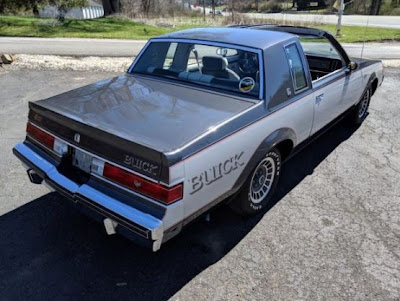
    • Blacked-out grille and headlamp door covers
    • Special Edition rally wheels w/Buick center caps
    • Front bucket seats w/black leather inserts throughout the whole interior
    • Leather-wrapped steering wheel
    • Center console w/shifter
    • Special Grand National gauge cluster 
    • Special Grand National badging on exterior and interior

    1982 Buick Grand National Gauge Cluster

    It's hard to find these cars in good shape. One of the biggest problems they had was through the years, their lack of power left a lack of enthusiasm to keep them running and looking good. The usual rust invades the lower doors and quarter panels in the usual places, and their interiors are commonly faded and torn from sun damage due to T-tops (some had sunroofs instead).  

    But these Grand Nationals can still be considered collector items thanks to their history and the lack of numbers produced. You could say they started a mid-to-late-'80s revolution of more desirable cars for the auto enthusiast, not to mention they paved the way for the '80s' most famous muscle car, the 1986 and '87 Grand National.   

    1982 Buick Grand National


    How Expensive Were They?

    The Grand Nationals weren't as expensive as buying a Corvette, but spending extra cheese on a Buick was something people didn't do much of since the muscle days. With a Regal sticker price of $8,702, you would have to cough up another $3,278 for the Grand National packages and about another $1,000 more if you ordered the turbo 3.8-liter version. With America in a recession at the time, that was a lot of money, and Buick's most expensive styling and performance package was one that it had ever sold. 

    1982 Buick Grand National 

    All in all, if you found one in good shape, it would be worth buying a 1982 Grand National just to preserve it. And if you found a 1983 Grand National, I have a bridge to sell you because there were no Grand Nationals made in '83. 

    Monday, July 6, 2026

    1977 Pontiac Can Am: The Ending of The Muscle Car Industry

    Multi-Purpose 1977 Pontiac Can Am


    Summary

  • The 1977 Pontiac Can Am was Pontiac's attempt to keep the muscle-car spirit alive during the late-1970s performance downturn.
  • Based on the LeMans Sport Coupe, it combined sporty styling, V8 power, and comfortable grand-touring features.
  • Powered by a 400-cu.-in. Pontiac V8 producing 200 hp and 325 lb.-ft. of torque.
  • Unique features included Cameo White paint, bold graphics, a special rear spoiler, Rally II wheels, and sport exhaust.
  • With a Turbo Hydra-Matic 400, heavy-duty suspension, and four-wheel power-assisted braking, it remained a respectable performer for 1977.
  • Pontiac planned to build around 5,000, but production ended after only about 1,377 cars due to problems with the fiberglass rear spoiler.
  • Today, its low production numbers, distinctive styling, and Pontiac muscle-car heritage make the Can Am a highly collectible and often-overlooked classic.
  • A short-lived Pontiac that proved the muscle-car spirit wasn't completely dead in the late '70s.

  • Pontiac Embelm


    Where and Why This Muscle Got Started and Ended

    By the late 1970s, the muscle car era had lost much of its momentum. Stricter emissions regulations, rising insurance costs, and the fuel crisis forced automakers to dial back performance. While many manufacturers focused on luxury and fuel economy, Pontiac refused to let performance disappear completely. In 1977, the division introduced a limited-production model that combined bold styling with respectable V8 power—the Pontiac Can Am.

    Built from the
    Pontiac LeMans Sport Coupe, the Can Am was designed to capture the excitement of Pontiac's legendary GTO while offering buyers a stylish personal luxury coupe with plenty of muscle. Although production lasted only a few months, the Can Am has become one of Pontiac's rarest and most collectible hidden gems.

    Multi-Purpose 1977 Pontiac Can Am


    Base Exterior Colors

    The 1977 Pontiac Can Am was offered in a single factory color—Cameo White. Every Can Am featured a distinctive appearance package that set it apart from the standard LeMans.
    Exterior highlights included:
    • Bold tri-color Can-Am hood and rear spoiler graphics.
    • Color-keyed rear spoiler
    • Blacked-out grille
    • Body-colored sport mirrors
    • Can-Am fender decals
    • Rally II wheels
    • Dual sport exhaust outlets
    • Aggressive shaker-inspired styling cues that hinted at Pontiac's muscle car heritage
    The combination of bright white paint and colorful graphics made the Can Am instantly recognizable and remains one of its defining characteristics today.

    Interior

    Inside, the Can-Am blended comfort with sporty styling. Buyers could choose from several interior color combinations depending on availability, while receiving many of Pontiac's upscale LeMans Sport features.
    Interior features included:
    • Strato bucket seats
    • Center console
    • Rally steering wheel
    • Engine-turned dashboard trim
    • Full instrumentation with tachometer
    • Sport door panels
    • Air conditioning available
    • Power windows and power door locks are available
    • Tilt steering wheel available
    • AM/FM stereo with optional 8-track player
    • Plush carpeting and generous sound insulation
    Rather than offering a stripped-down muscle car interior, Pontiac gave the Can Am the feel of a comfortable grand touring coupe.


    Multi-Purpose 1977 Pontiac Can Am


    Engine, Performance, Wheels, Brakes, and Tires

    Performance Specifications

    • Engine: 400 cubic-inch (6.6-liter) Pontiac V8
    • Horsepower: 200 hp
    • Torque: 325 lb-ft
    • Transmission: Turbo Hydra-Matic 400 three-speed automatic
    • Rear Axle Ratio: 3.08:1
    • 0–60 mph: Approximately 8.0 seconds
    • Quarter-Mile: Around 16.0 seconds
    • Top Speed: Approximately 120 mph

    Wheels, Brakes & Tires

    • 15-inch Pontiac Rally II wheels
    • GR70-15 steel-belted radial tires
    • Power front disc brakes
    • Rear drum brakes
    • Heavy-duty suspension package
    • Front and rear sway bars
    • Variable-ratio power steering
    While those performance numbers may seem modest compared to the peak muscle car years, the Can Am remained one of the quickest intermediate-sized American cars available in 1977.

    A Short-Lived Legend

    The Pontiac Can Am's story is as interesting as the car itself. Pontiac originally planned to build approximately 5,000 units, believing there was still a market for stylish American performance cars. However, production came to an abrupt halt after a supplier responsible for manufacturing the fiberglass rear spoiler experienced serious manufacturing problems. Rather than redesign the package or find another supplier, Pontiac ended production after only about 1,377 cars had been completed.

    Because of its extremely limited production run, the Can Am has become something of a forgotten classic. It shares much of its mechanical DNA with other popular
    Pontiac models of the era, making restoration relatively straightforward, while its unique graphics, spoiler, and trim pieces are far more difficult to locate. Enthusiasts appreciate the Can Am not only for its rarity but also because it represents Pontiac's determination to keep the spirit of American performance alive during one of the industry's most challenging periods.

    Today, the Can Am enjoys a loyal following among collectors who value uncommon muscle cars. At classic car shows, it's not unusual for spectators to mistake one for a customized LeMans until they notice the distinctive graphics and factory-installed spoiler. Its rarity often makes it more intriguing than many higher-production muscle cars from the same decade.


    Multi-Purpose 1977 Pontiac Can Am


    Overlooked or Not—The Better The Story and Rarity—the More Collectible

    The 1977 Pontiac Can Am stands as one of General Motors' most overlooked performance cars. Produced for just a single model year and limited to roughly 1,377 examples, it represents a fascinating chapter in Pontiac history. Combining eye-catching styling, dependable V8 power, and comfortable touring manners, the Can Am proved that excitement hadn't completely disappeared from American showrooms during the late 1970s.

    Although its production was cut short by circumstances beyond Pontiac's control, that unexpected ending helped transform the Can Am into a true collector's item. Nearly five decades later, it remains a favorite among Pontiac enthusiasts who appreciate rare factory muscle cars with an interesting backstory. Whether admired for its striking appearance, limited production numbers, or its place in Pontiac's performance legacy, the 1977 Can Am continues to remind enthusiasts that some of the most memorable classics are the ones almost forgotten.

    Friday, May 15, 2026

    The Chevrolet Camaro: Sports Cars That Rocked Generations.

    Few cars have shaped American performance culture quite like the Chevrolet Camaro. From drag strips and road courses to Hollywood movies and late-night street races, the Camaro has remained one of the most respected names in the muscle car world.

    Here’s a look at some of the most legendary Camaros ever built and why enthusiasts still obsess over them today.


    1967 Camaro — The Beginning of a Legend


    What Camaro Do You Think Is The Hottest? 1967 Camaro


    The first-year Camaro instantly gave Chevrolet a serious competitor in the pony car wars. Designed to battle the Ford Mustang, the 1967 Camaro arrived with aggressive styling, endless engine options, and a performance attitude that immediately connected with young enthusiasts.

    What made the ’67 Camaro so important was its versatility. Buyers could build anything from a stylish cruiser to a street-dominating big-block monster. It became the foundation for decades of Camaro performance and helped launch Chevrolet into a new era of muscle car dominance.

    Performance Highlights

    • Available inline-six and V8 engine options
    • Optional 396 cubic-inch big-block V8
    • Aggressive long-hood, short-deck styling
    • Excellent aftermarket support even today
    • One of the most customizable muscle cars ever built


    1969 Camaro Z/28 — Road Racing Royalty


    1969 Camaro Z/28

    The 1969 Chevrolet Camaro Z/28 is one of the most respected muscle cars in history. Originally built to compete in Trans-Am racing, the Z/28 focused less on straight-line drag racing and more on handling, balance, and high-revving performance.

    Its legendary 302 small-block V8 became famous for screaming RPMs and race-inspired engineering. Today, the ’69 Z/28 is considered one of the most collectible Camaros ever produced and remains a symbol of Chevrolet performance.

    Performance Highlights

    • High-revving 302 cubic-inch V8
    • Four-speed manual transmission
    • Improved suspension tuning
    • Front disc brakes
    • Inspired directly by Trans-Am racing


    COPO 427 Camaro — The Factory Drag Racer


    1969 Black COPO Camaro

    The COPO Camaro was Chevrolet’s secret weapon during the peak muscle car era. Officially, GM restricted engine sizes in midsize and pony cars, but clever dealers found a loophole through the Central Office Production Order system.

    The result was a brutally powerful Camaro stuffed with the monstrous 427 big-block V8. These cars became legends at drag strips across America and are now among the rarest and most valuable Camaros ever built.

    Performance Highlights

    • Massive 427 cubic-inch big-block V8
    • Built specifically for drag racing
    • Extremely limited production numbers
    • Lightweight performance-focused setup
    • Serious collector value today


    Yenko Camaro — Dealer-Built Muscle Madness


    1969 Yenko Camaro Blue


    The Yenko Camaro became legendary thanks to performance dealer Don Yenko, who transformed Camaros into street-legal race cars. Yenko Camaros packed brutal horsepower and aggressive styling that terrified competitors on both the street and strip.

    These cars became icons because they represented the wild west era of American horsepower before emissions regulations and insurance crackdowns changed everything. 

    Performance Highlights

    • Tuned 427 big-block power
    • Performance suspension upgrades
    • Distinctive Yenko striping and badging
    • Extremely rare production numbers
    • One of the most collectible dealer muscle cars ever


    1969 Camaro ZL1 — The Unicorn Camaro


    1969 Camaro ZL1-Bad In Black

    The 1969 Chevrolet Camaro ZL1 is often considered the holy grail of Camaros. Only a handful were built, making it one of the rarest and most expensive muscle cars ever produced.

    Its all-aluminum 427 engine delivered outrageous performance for the era. The ZL1 shocked the automotive world by combining lightweight construction with race-ready horsepower.

    Performance Highlights

    • All-aluminum 427 V8
    • Factory-built drag racing monster
    • Ultra-lightweight engine design
    • Extremely low production numbers
    • Six-figure collector car status


    1970–1973 Split-Bumper RS/SS — Peak Camaro Styling


    1970–1973 Split-Bumper RS/SS


    The second-generation Chevrolet Camaro RS/SS introduced smoother body lines, better handling, and arguably the most iconic Camaro front-end design ever created.

    The split-bumper setup became an instant classic and helped define 1970s Camaro styling. These cars balanced muscle car aggression with sports car-inspired handling characteristics.

    Performance Highlights

    • Distinctive split front bumper design
    • Available big-block and small-block V8s
    • Improved chassis balance
    • Better cornering than earlier Camaros
    • One of the most recognizable Camaro designs ever


    1970½ Camaro — The Handling Revolution


    1970 1/2 Camaro


    The 1970½ Camaro represented a major shift in Chevrolet engineering philosophy. Instead of focusing only on straight-line speed, Chevrolet developed a car that could genuinely compete in corners.

    This Camaro earned respect because it blended muscle car power with true sports car handling. Many enthusiasts still consider it one of the best-driving classic Camaros ever made.

    Performance Highlights

    • Improved suspension geometry
    • Better weight distribution
    • Enhanced steering feel
    • Aggressive low-slung body design
    • Strong small-block and big-block engine options


    1985–1990 IROC-Z — The King of the 1980s


    Black 1985–1990 IROC-Z


    The Chevrolet Camaro IROC-Z became the ultimate symbol of 1980s performance culture. Named after the International Race of Champions series, the IROC-Z combined bold styling with improved handling and fuel-injected V8 power.

    For an entire generation, the IROC-Z was the dream street machine. It dominated posters, music videos, and cruising scenes everywhere.

    Performance Highlights

    • Tuned Port Injection V8 engines
    • Lowered performance suspension
    • Distinctive ground effects and wheels
    • Improved aerodynamics
    • One of the hottest performance cars of the 1980s


    1996 Camaro SS — Modern Muscle Returns


    1996 Camaro SS

    The 1996 Chevrolet Camaro SS helped bring serious performance back to the Camaro lineup during the 1990s. Built with help from SLP Engineering, the SS package added more power, aggressive styling, and improved exhaust performance.

    It represented the rebirth of modern Chevrolet muscle and became a favorite among street racers and performance enthusiasts.

    Performance Highlights

    • LT1 V8 performance
    • Functional hood scoop design
    • SLP performance upgrades
    • Strong acceleration capabilities
    • Aggressive fourth-gen styling


    1998 Camaro SS — LS1 Power Changed Everything


    1998 Camaro SS


    The 1998 Chevrolet Camaro SS introduced the legendary LS1 engine platform to Camaro fans. This lightweight aluminum V8 transformed the Camaro into one of the fastest American performance bargains of its era.

    The LS platform would go on to become one of the most influential performance engine families ever created.

    Performance Highlights

    • LS1 aluminum V8 engine
    • Massive aftermarket tuning potential
    • Excellent power-to-weight ratio
    • Strong drag racing reputation
    • Affordable high-performance platform


    1998 Camaro SS — LS1 Power Changed Everything


    2002 Camaro SS 35th Anniversary

    The 2002 Chevrolet Camaro SS 35th Anniversary marked the end of Camaro production before its temporary discontinuation. Enthusiasts immediately recognized these cars as future collectibles.

    This generation closed the chapter on classic rear-drive F-body performance before the Camaro disappeared for several years.

    Performance Highlights

    • Special anniversary appearance package
    • LS1 V8 performance
    • Collector-focused production
    • Strong performance value
    • Final year of fourth-generation production


    2014–2015 Camaro Z/28 — The Track Monster

    2015 Camaro Z28

    The modern Chevrolet Camaro Z/28 revived the legendary Z/28 name with an all-out track-focused mission. Inspired partly by the aggressive heritage of the 1969 Z/28 and boosted by Camaro popularity from the Transformers films, this Camaro became an instant icon.

    Instead of focusing purely on horsepower numbers, Chevrolet engineered the Z/28 to dominate road courses with incredible suspension tuning, aerodynamics, and braking performance.

    Performance Highlights

    • Naturally aspirated 7.0L LS7 V8
    • Track-focused suspension tuning
    • Massive carbon-ceramic brakes
    • Extreme aerodynamic package
    • Nürburgring-tested performance


    2016–2024 Camaro ZL1 1LE — The Ultimate Camaro


    2016–2024 Camaro ZL1 1LE


    The Chevrolet Camaro ZL1 1LE represents the absolute peak of factory Camaro performance. Combining supercharged power with race-ready handling, the ZL1 1LE became one of the fastest American cars ever produced.

    Its track capability shocked the automotive world by outperforming exotic sports cars costing far more money. Many enthusiasts consider it the greatest Camaro ever built.

    Performance Highlights

    • Supercharged 6.2L LT4 V8
    • Over 650 horsepower
    • Advanced aerodynamic package
    • Multimatic DSSV suspension
    • Extreme track-day capability
    • Nürburgring-level performance engineering


    All Good Things Must Come To An End 


    Four Generation of Camaros


    The Camaro legacy stretches across generations of American performance culture. Whether it’s a rare big-block drag car, a road-racing Z/28, or a modern supercharged track weapon, every era of Camaro brought something unique to the muscle car world.

    From the streets of the late 1960s to modern racetracks, the Camaro remains one of Chevrolet’s greatest performance achievements and one of the most beloved American cars ever created.

    Sunday, May 10, 2026

    Chevrolet Off-Road Trucks Built Bad-To-The-Bone From The Factory


    Chevy Trucks


    Summary 

  • Chevy has built some of the toughest off-road trucks ever, from classic trail rigs to modern factory-built monsters.
  • Silverado 1500 ZR2 — 6.2L V8, 420 hp, DSSV suspension, locking differentials, and 33-inch mud tires.
  • Colorado ZR2 Bison — compact and highly capable, with AEV steel bumpers, skid plates, locking differentials, and 310-hp TurboMax engine.
  • K5 Blazer — an old-school off-road icon with V8 power, removable top, short wheelbase, and legendary trail capability.
  • Silverado HD ZR2 — combines heavy-duty towing and hauling strength with serious off-road hardware and available Duramax diesel power.
  • C10 — the ultimate custom-truck platform, with endless possibilities for lifted, mud, and desert builds.
  • From simple and mechanical to high-tech and powerful, Chevy has proven it knows how to build trucks that can leave the pavement behind.


    Chevy Bowtie


  • The Baddest Off-Road Chevrolet Trucks Ever Built


    Chevrolet has built some seriously tough trucks over the years, but a few stand out as true legends in the off-road world. From factory-built desert runners to classic mud-slinging monsters, these Chevy trucks have earned their reputation through power, capability, and aggressive styling. Here’s a quick look at some of the baddest off-road Chevrolet trucks ever made.


    Chevrolet Silverado 1500 ZR2


    Chevrolet Silverado 1500 ZR2 — The Ultimate Modern Off-Road Chevy

  • 6.2L V8 engine with 420 horsepower
  • Multimatic DSSV spool-valve suspension
  • Front and rear electronic locking differentials
  • Factory 33-inch mud-terrain tires
  • High ground clearance for trails and rocks
  • Aggressive factory styling package
  • Strong towing capability for an off-road truck
  • Comfortable interior with modern technology
  • The Silverado ZR2 is Chevy’s ultimate full-size off-road truck straight from the factory. Built to compete with trucks like the Ford Raptor and Ram TRX, the ZR2 mixes serious trail capability with everyday drivability. Powered by a massive 6.2-liter V8 pushing out 420 horsepower, this truck has more than enough muscle for mud, sand, rocks, or towing duties.

    What makes the ZR2 special is its Multimatic DSSV spool-valve suspension system. These advanced shocks help the truck stay controlled over rough terrain while still riding comfortably on the street. Add in locking front and rear differentials, 33-inch mud-terrain tires, skid plates, and aggressive styling, and you’ve got one of the toughest factory Chevys ever built.


    Chevrolet Colorado ZR2 Bison


    Chevrolet Colorado ZR2 Bison — The Rock Crawling Beast

  • Excellent rock-crawling capability
  • Compact size for tighter trails
  • AEV steel bumpers and skid plates
  • Lifted suspension with off-road tuning
  • Front and rear locking differentials
  • Durable underbody protection
  • Aggressive all-terrain tire setup
  • Strong balance of daily driving and trail performance
  • High-output 2.7-liter TurboMax® 4-cylinder engine delivering 310 horsepower and 430 lb-ft of torque 
  • The Colorado ZR2 Bison proves that bigger isn’t always better. This midsize off-road truck was designed for serious trail work and technical terrain where a full-size pickup can feel too bulky. Developed with help from American Expedition Vehicles (AEV), the Bison package adds heavy-duty skid plates, steel bumpers, and larger tires.

    Under the hood, the Colorado ZR2 delivers strong power with a high-output 2.7-liter TurboMax® 4-cylinder engine pumping out 310 horsepower and 430 lb-ft of torque. That engine combo is a good fit for this truck, which is compact enough to maneuver through heavy traffic and tight trails. Its lifted suspension and locking differentials make it one of the most capable rock crawlers Chevy has ever offered from the factory.


    Chevrolet K5 Blazer


    Chevrolet K5 Blazer — The Old-School Off-Road Legend

  • Available V8 engine power
  • A short wheelbase improves off-road maneuverability
  • Classic removable top design
  • Durable body-on-frame construction
  • Huge aftermarket support
  • Legendary mud and trail capability
  • Iconic vintage styling
  • Simple mechanical setup makes modifications easy
  • Few classic off-road vehicles look tougher than the Chevrolet K5 Blazer. Introduced in the late 1960s, the K5 combined full-size truck strength with SUV versatility long before modern SUVs became popular. With removable tops, big V8 power, and solid axle toughness, the K5 became a favorite among off-road enthusiasts and mud boggers.

    The short wheelbase helped it handle rough terrain better than many trucks of its era, while the classic boxy design still turns heads today. Whether restored or heavily modified, the K5 Blazer remains one of Chevy’s most iconic off-road machines.


    Chevrolet Silverado HD ZR2


    Chevrolet Silverado HD ZR2 — Heavy-Duty Meets Off-Road

  • Available Duramax diesel engine with massive torque
  • Heavy-duty towing and hauling capability
  • Upgraded off-road suspension system
  • Front and rear locking differentials
  • Large all-terrain tires for rough terrain
  • Skid plates for added protection
  • Huge cabin and cargo space
  • Combines work-truck toughness with trail performance
  • The Silverado HD ZR2 takes Chevy’s heavy-duty platform and transforms it into a surprisingly capable off-road machine. This truck is huge, powerful, and built for people who want serious towing capability without giving up trail performance.

    Available with the legendary Duramax diesel engine, the HD ZR2 delivers massive torque while featuring upgraded suspension components, skid plates, locking differentials, and aggressive all-terrain tires. Its size alone gives it an intimidating presence, but it still manages to handle rough terrain better than most trucks this large have any business doing.


    Chevrolet C10


    Chevrolet C10 — The Custom Truck King

  • Lightweight classic truck platform
  • Endless customization possibilities
  • Popular for lifted off-road builds
  • Strong aftermarket performance support
  • Easy engine swap potential
  • Classic square-body styling
  • Durable frame and simple mechanics
  • Huge fan base and collector appeal
  • The Chevrolet C10 may not have started life as a hardcore off-road truck, but custom builders turned it into a legend. Whether lifted sky-high on mud tires or transformed into a prerunner-style desert truck, the C10 became one of the most modified Chevy trucks ever made.

    Its simple design, lightweight body, and endless aftermarket support made it perfect for customization. Big-block V8 swaps, lifted suspensions, and aggressive off-road builds helped the C10 earn a permanent place in truck culture.


    Cool Silverado Custom


    Lots of Competition, but Chevy Still Stands Tall

    Chevrolet has built some incredible off-road machines over the decades, ranging from classic trail rigs to modern high-tech monsters. The Silverado ZR2 leads the pack as Chevy’s most advanced factory-built off-road truck, while legends like the K5 Blazer and C10 continue to dominate the custom scene. No matter which one you prefer, these trucks prove Chevy knows how to build something tough enough to leave the pavement behind.


    1959 Corvette: Unbeatable Purple People Eater MKIII

         Summary Born to stand out: The Corvette team painted their cars metallic purple with white trim so they could actually find them in th...